Every few years a new channel reaches the point where ignoring it stops being a strategy and starts being a liability. Social media reached that point around 2012. Mobile search reached it around 2015. AI-powered information retrieval is reaching it now.
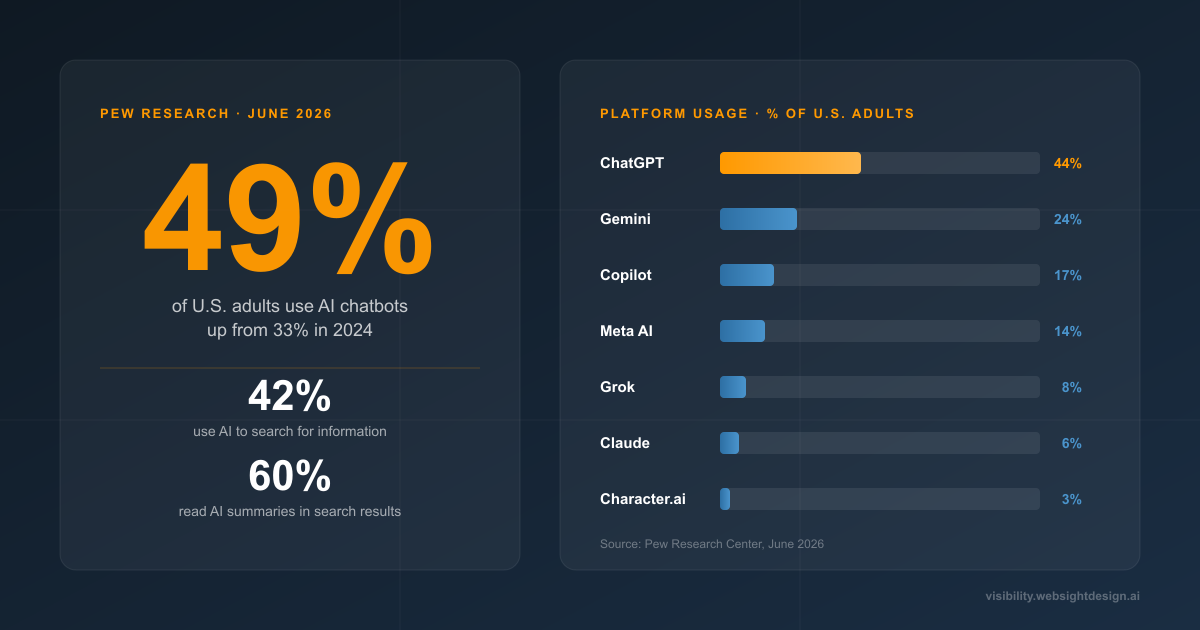
Pew Research's June 2026 survey of U.S. adults puts the most credible numbers yet on how far this shift has progressed. The headline figure is familiar in shape but significant in scale: 49% of Americans now use AI chatbots. What is less discussed, and more important for businesses, is what they are using them for.
The Information-Seeking Number That Matters
When Pew asked chatbot users how they use these tools, information searching came out on top. 42% of chatbot users turn to AI specifically to find information, making it the most common use case, ahead of work tasks (38%), entertainment (25%), and image or video creation (24%).
Four in ten chatbot users now treat AI as a primary information source, the first place they turn when they have a question, not a supplementary tool they reach for occasionally.
This is the number businesses need to sit with. The question “What is the best [service] in [city]?” is now being asked of ChatGPT, Gemini, Claude, and Perplexity as often as it is being typed into Google. And unlike a search results page, which returns a list of options and lets the user decide, an AI chatbot returns an answer. It names specific businesses. It describes them. It recommends or omits them based on what it knows.
If an AI tool ignores your business, represents it inaccurately, or never surfaces it for relevant queries, every customer who asks that question and gets a competitor’s name is a conversion your business lost.
Who Is Using AI Chatbots and How Often
The adoption trajectory over the past three years is striking. ChatGPT usage has gone from 18% of U.S. adults in 2023 to 44% in 2026. That is not incremental growth. That is normalization.
| Platform | U.S. Adult Usage (2026) |
|---|---|
| ChatGPT | 44% |
| Gemini | 24% |
| Copilot | 17% |
| Meta AI | 14% |
| Grok | 8% |
| Claude | 6% |
| Character.ai | 3% |
Source: Pew Research Center, June 2026. Percentage of U.S. adults reporting use of each platform.
The frequency data is equally telling. Of the 49% who use chatbots at all, approximately 24% use them daily. That includes 12% who use them several times a day and 4% who use them almost constantly. This is habitual use, not occasional experimentation.
The implication is that the audience reaching your category through AI tools is not a fringe. It is close to half the adult population, and a meaningful portion of them are asking questions every day.
The Search Summary Layer Is Already Mainstream
Beyond standalone chatbot apps, the Pew data captures a second, equally important shift: 60% of Americans who use search engines report reading AI-generated summaries in their results.
Three in five searchers are now reading an AI answer before they decide whether to click anything at all. The traditional model, where your title and meta description compete for the click, now has a layer on top of it.
This is Google's AI Overviews, Bing's AI-powered summaries, and the growing presence of AI-synthesized answers at the top of results pages. In these summaries, Google and Bing cite sources, but the user reads the answer first. Whether they click through at all depends on whether the summary satisfied their question, and whether your brand was named as part of that answer.
Taken together, chatbot usage and AI search summaries mean that AI-mediated information retrieval is now touching the majority of American internet users in some form. The question of whether your audience uses AI to find information is effectively settled. They do.
What People Are Asking AI About
Beyond the headline use cases, the survey details paint a clearer picture of the queries AI is now expected to answer:
- Medical advice: 20% of chatbot users have asked for health-related guidance. For healthcare businesses, clinics, or wellness brands, AI is now a channel where patients are forming opinions before they call or book.
- Diet and fitness information: 20% have used chatbots for nutrition or fitness queries. This is a high-intent research behavior that leads to product and service decisions.
- News and current events: 13% use AI for news. Businesses that are newsworthy, or operate in news-adjacent industries, need to think about how AI tools synthesize and represent their category.
- Work-related tasks: 38% of employed adults use chatbots for work. In B2B contexts, procurement researchers, agency buyers, and business owners are turning to AI to evaluate vendors and service providers.
In each of these use cases, a named business, product, or service is often part of what the AI returns. The AI does not just explain concepts; it recommends, compares, and evaluates. Your brand is either in that conversation or it is not.
The Trust Gap and What It Means
Americans are not embracing AI uncritically. The Pew data makes that clear. Forty percent of adults expect AI to have a negative impact on society over the next 20 years. Only 16% expect a positive impact. Sixty-three percent say AI is advancing too quickly. Seventy-one percent believe AI will make their personal information less secure.
This matters for one specific reason: skeptical users apply more scrutiny to AI answers, not less. A user who distrusts AI but uses it anyway because it is convenient is more likely to click through and verify a specific claim. They are also more likely to notice if an AI gets something wrong about your business and form a negative impression as a result.
Inaccurate AI representations are not a minor nuisance. For a business whose customers are already cautious about AI-generated information, a factual error in a ChatGPT response about your services, location, or credentials can actively damage trust before the customer ever reaches your website.
What Businesses Should Take From This
The Pew numbers confirm what forward-looking marketers have been watching for two years. AI chatbots have crossed from early adoption into mainstream use, and information searching is their primary function. Here is what that requires in practical terms.
Know what AI says about you right now
The starting point is accuracy. Ask ChatGPT, Gemini, Perplexity, and Claude about your business by name. Ask what you do. Ask for recommendations in your category in your city. The responses reveal what these systems currently know, what they get wrong, and whether you appear at all.
Most businesses have never done this. They are optimizing for a search results page while their customers are getting answers from a system they have never audited.
Build content that answers the questions your customers are asking AI
AI systems cite sources. The content they cite is content that directly, clearly, and completely answers specific questions. If your website answers the questions your customers are asking chatbots, your content is more likely to be in the pool AI tools draw from.
This is about writing content that resolves specific questions with specificity and depth. Keyword density and technical tricks miss the point. A page that genuinely answers “What should I look for in a [service provider] in [city]?” is more citable than a homepage that says “We are the best.”
Maintain factual consistency across every public source
AI language models synthesize information from multiple sources, including your website, review platforms, directories, news articles, and social profiles. Inconsistencies across those sources, different addresses, outdated service descriptions, conflicting hours, create confusion in AI outputs. AI tools inherit the errors in their training data.
Factual hygiene across every indexed source about your business is not just good housekeeping. It directly affects the accuracy of what AI says about you.
Track AI visibility as a separate performance metric
If 42% of chatbot users are turning to AI for information, and those users represent close to half the adult population, then AI visibility is a meaningful acquisition channel. It deserves measurement, not just assumption.
This means tracking your citation rate across platforms, monitoring whether your business appears in relevant category queries, and watching your AI-referred traffic in Google Analytics as a leading indicator of citation performance.
The Window Is Not Closed, But It Is Narrowing
In 2023, businesses that ignored AI search behavior had a reasonable excuse: the tools were new, the user base was small, and the impact was speculative. That argument no longer holds. Pew Research is not a tech industry source with an agenda. It is a nonpartisan survey organization reporting that nearly half of American adults now use these tools, primarily to find information.
The brands investing now in AI citation accuracy and visibility are building a presence in a channel that is still growing. The brands waiting for AI search to mature before engaging are ceding that ground to competitors who are already there.
The question your customers are asking AI about your category will get answered regardless. The only variable is whether your business is in that answer.
Tracking whether your business appears in these AI responses requires ongoing measurement. The AI brand visibility audit tests your presence across ChatGPT, Claude, Gemini, and Perplexity using the same discovery and recommendation prompts your customers are now typing. If you want to see your current standing, run a free audit — it covers all four platforms and delivers results by email within a few hours.
Source
- Americans and AI 2026: Chatbots, Smart Devices, and Views on Impact, Pew Research Center, June 17, 2026